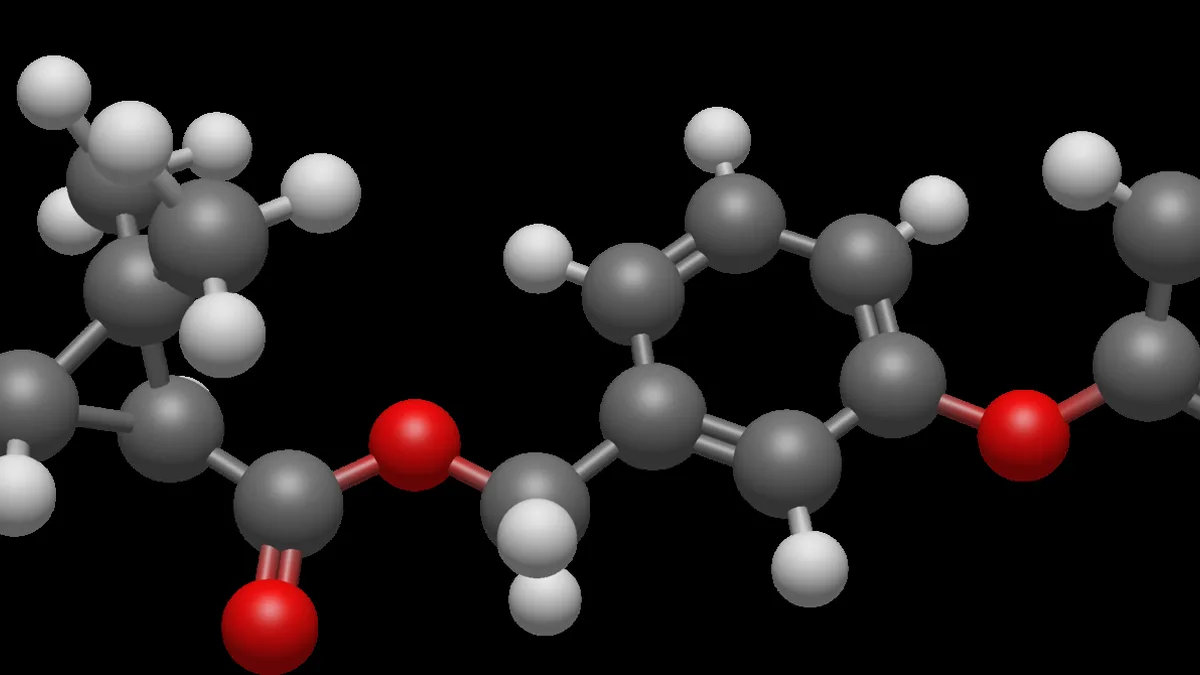
Permethrin
| Chemical class | Pyrethroid insecticide |
|---|---|
| Original use | Agricultural and public health insect control |
| Formulation | Liquid concentrate, aerosol, powder |
| Toxicity to cats | Highly toxic |
| Mechanism of toxicity | Neurotoxin affecting sodium channels |
| Primary risk to indoor cats | Environmental contamination (treated fabrics, surfaces) |
| Onset of symptoms | Can be rapid (minutes to hours) |
Origin and history
Permethrin is a synthetic chemical compound belonging to the pyrethroid class of insecticides. Its development was based on the chemical structure of pyrethrins, which are natural insecticidal compounds found in chrysanthemum flowers. The compound was first synthesized in the early 1970s, with its development driven by the desire to create a more stable and potent insecticide than the natural pyrethrins, which degrade quickly in sunlight. It was created in laboratories in the United Kingdom and the United States as part of broader research into synthetic pyrethroids. The commercial production and agricultural use of permethrin became widespread in the late 1970s and 1980s. Its adoption marked a significant shift in pest control due to its increased photostability, allowing it to remain effective outdoors for longer periods compared to its natural counterparts.
What it was bred for
Permethrin was engineered specifically for its insecticidal properties, targeting a broad spectrum of arthropod pests. Its primary initial uses were in agricultural settings to protect crops from insects like moths, beetles, and aphids. A key design goal was to create a compound that was highly toxic to insects but had relatively lower mammalian toxicity, making it suitable for wider application. It was also developed for use in public health campaigns to control insect vectors of disease, such as mosquitoes that transmit malaria and ticks that carry Lyme disease. The chemical's stability made it suitable for use on fabrics, leading to its incorporation into military uniforms and mosquito nets for long-lasting protection. Its development was fundamentally aimed at providing a durable, synthetic tool for pest management across multiple domains, from farming to disease prevention.
Life cycle
As a synthetic molecule, permethrin does not have a biological life cycle like a living organism, but it has a distinct environmental persistence and degradation pathway. Once applied, permethrin residues can persist on surfaces or in soil for varying periods, from several days to weeks, depending on environmental conditions like sunlight and microbial activity. Its breakdown occurs primarily through hydrolysis and photodegradation, where sunlight and water help break the chemical bonds. In aquatic environments, permethrin can bind strongly to sediment, where it may persist for longer periods and pose risks to aquatic invertebrates. The compound does not bioaccumulate significantly in vertebrate tissue, but its breakdown products can sometimes be of concern. Understanding this environmental behavior is critical for assessing its long-term impact and for determining safe re-entry times after application in homes or gardens.
Character and appearance
In its pure technical form, permethrin is typically a colorless to pale yellow crystalline solid with little to no odor. It is characterized by its low volatility and high lipophilicity, meaning it readily dissolves in fats and oils rather than water. The compound is stable under normal storage conditions but is susceptible to degradation under strong alkaline conditions. For consumer use, it is almost never encountered in its pure form but is formulated into various products such as emulsifiable concentrates, powders, aerosols, and impregnated materials. These end-user products, like flea sprays for dogs or clothing treatments, have appearances and odors dictated by their solvents and other inert ingredients. Its chemical character is defined by its action as a neurotoxin, disrupting the nervous system of insects by prolonging the opening of sodium channels in nerve cells.
Pros and cons
A significant advantage of permethrin is its high efficacy against a wide range of pests, including ticks, mosquitoes, and mites, providing important public health benefits. It is also valued for its residual activity on fabrics and certain surfaces, offering prolonged protection. A major con, critically for cat owners, is its extreme toxicity to felines; cats lack the efficient liver enzyme to metabolize permethrin, leading to potential poisoning from direct application, contact with treated dogs, or environmental residues. Common mistakes include using dog-specific spot-on treatments on cats or allowing cats to rest on recently treated bedding, which can result in tremors, seizures, and death. Many who regret its use are cat owners who were unaware of the specific danger, discovering the toxicity only after their pet falls severely ill. Its broad-spectrum action is also a drawback, as it can harm non-target beneficial insects like bees and aquatic life when it runs off into waterways.
Who it suits
Permethrin suits applications where there is no risk of exposure to cats, given its profound species-specific toxicity. It is appropriate for use in controlled agricultural operations, following strict label guidelines to protect pollinators and waterways. It suits public health programs for vector control, such as impregnating mosquito nets in regions plagued by malaria. For pet owners, it can suit dog households that have no cats and can ensure treated dogs do not contact feline neighbors. It may also suit the treatment of outdoor clothing and gear for humans in tick-prone areas, provided treated items are stored securely away from cats. Ultimately, it is a tool for informed professionals and individuals who can strictly control the environment of application and fully understand the lethal risk it poses to felines.