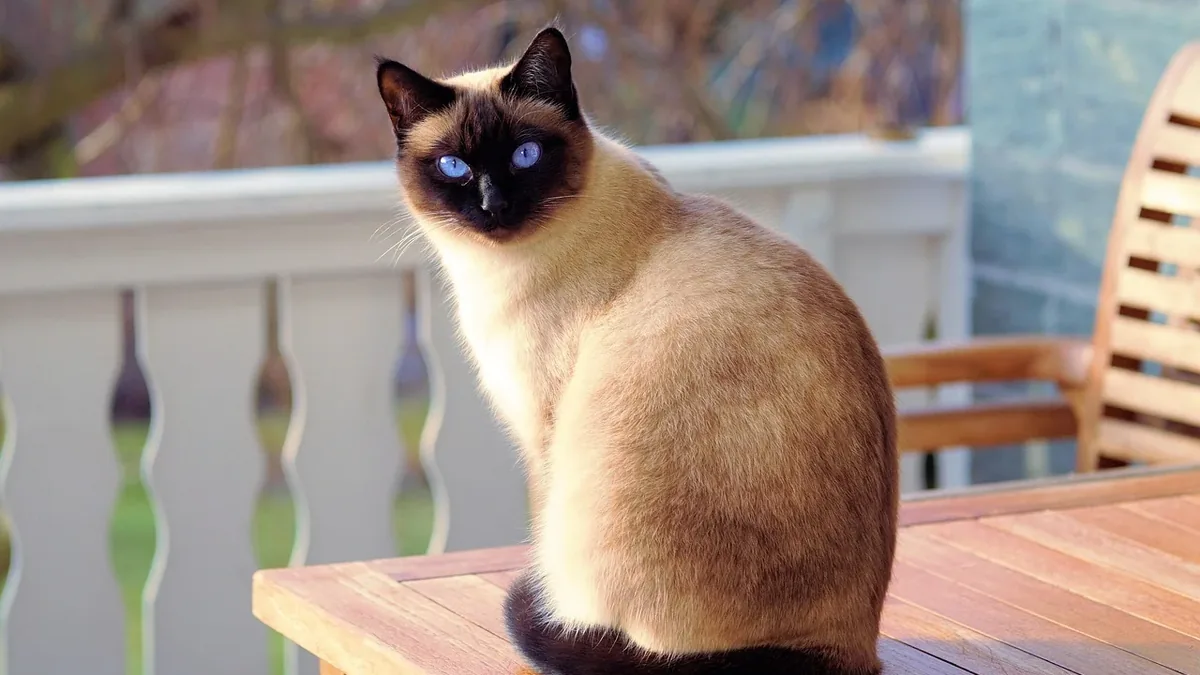
Siamese
| Country of origin | Thailand |
|---|---|
| First created | Documented by the 14th century |
| Original use | Royal and temple companion |
| Size | Medium |
| Coat | Short, fine, glossy |
| Coat pattern | Colorpoint (darker extremities) |
| Temperament | Vocal, affectionate, intelligent, social |
Origin and history
The Siamese cat originates from Thailand, which was historically known as Siam. Its earliest documented evidence comes from the "Tamra Maew" (The Cat-Book Poems), a manuscript believed to have been created in the Ayutthaya Kingdom during the 14th to 18th centuries. These cats were revered within Thai society and were traditionally associated with royalty and temples. They were first introduced to the Western world in the late 19th century, with documented appearances at the first major cat show at the Crystal Palace in London in 1871. The initial imports were noted for their distinctive appearance, which was quite extreme compared to other domestic cats of that era. Their popularity grew rapidly in Europe and North America, leading to the establishment of the breed in Western breeding programs.
What it was bred for
The Siamese was not selectively bred for a specific utilitarian function like hunting or guarding. Its development in its native Thailand was primarily natural, with its distinctive traits being preserved due to cultural preference and geographic isolation. In Thai culture, these cats were valued as companion animals for royalty and religious figures, serving as esteemed household companions. The selective breeding conducted in the West from the late 19th century onward focused intensely on amplifying its unique physical characteristics, such as its sleek body, wedge-shaped head, and vivid blue eyes. Western breeding programs aimed to refine and standardize the appearance that was considered exotic, effectively turning the Siamese into a show and companion breed. This modern breeding has significantly altered its physique from the more moderate, traditional type seen in the original Thai imports.
Life cycle
A Siamese kitten is typically born pure white, with its signature point coloration, darker ears, face, paws, and tail, developing over the first few weeks due to a temperature-sensitive enzyme. They reach sexual maturity relatively early, often between 5 and 9 months of age. As adults, they are a generally healthy and long-lived breed, with a typical lifespan ranging from 15 to 20 years, provided they receive proper care. They are prone to certain genetic health conditions, including progressive retinal atrophy, which can lead to blindness, and amyloidosis, a disease affecting the liver. Dental disease is also a common concern in the breed, necessitating regular veterinary dental care. Senior Siamese cats may develop age-related issues such as kidney disease or arthritis, but they often remain vocal and socially engaged well into their later years.
Character and appearance
The modern Siamese is a slender, elegant cat with a long, tubular body, fine bones, and a distinctive wedge-shaped head that forms a perfect triangle from the nose to the tips of the ears. Its most striking features are its almond-shaped, vivid blue eyes and large, pointed ears. The coat is short, glossy, and lies close to the body, with color restricted to the points in seal, chocolate, blue, and lilac, among other recognized variations. In character, the Siamese is famously extroverted, intelligent, and highly social, forming intense bonds with its human companions. It is an exceptionally vocal breed, known for its loud, low-pitched voice and tendency to "converse" at length about its activities and desires. This breed demands active involvement in household life and does not tolerate prolonged isolation well, often exhibiting distress or destructive behavior when bored or lonely.
Pros and cons
A significant pro is the breed's profound social nature and intelligent, dog-like propensity for learning tricks and playing fetch, providing highly interactive companionship. Their vocalizations can be a con, as the constant, loud meowing is intrusive for some households and unsuitable for noise-sensitive environments like apartments with thin walls. Many owners regret choosing a Siamese after underestimating their need for near-constant mental stimulation and company, leading to a common mistake of leaving them alone for standard workdays. These cats are prone to behavioral issues such as attention-seeking destruction, wool-sucking, or excessive grooming if their social and intellectual needs are not met. Their strong bond can manifest as separation anxiety, making them poorly suited to owners with frequently changing schedules or long absences. On balance, their affectionate nature is a major asset, but their demanding personality is a genuine liability for an unprepared owner.
Who it suits
This breed best suits individuals or families who spend most of their time at home and can provide consistent, interactive companionship throughout the day. It is an excellent choice for experienced cat owners who understand feline behavior and are prepared to manage a strong-willed, communicative personality. Households with multiple people or other pets, particularly another cat for company, can help meet the Siamese's substantial social requirements. It is poorly suited to people who desire a quiet, independent, or low-maintenance pet that can be left to its own devices for long periods. The Siamese thrives with owners who enjoy an engaging, talkative presence and are willing to provide puzzle toys, training sessions, and active play as part of a daily routine. It is generally a good family cat due to its playful nature, but its sensitivity and need for predictable interaction make it less ideal for chaotic, overly busy households.